In Brief
Moving an AI agent from a demo to production requires building a secure, enterprise-grade architecture around the model rather than focusing solely on the model itself.
Key Takeaways
- Infrastructure Over Models: Production readiness relies on seven critical non-model capabilities: VPC isolation, IAM controls, KMS encryption, CI/CD automation, observability, governance, and human-in-the-loop controls.
- Safety via Orchestration: Secure integration with enterprise software (Salesforce, SAP, databases) occurs at the orchestration layer, which governs permissions, data lineage, and action validation.
- Faster Time-to-Value: Leveraging pre-built, compliant infrastructure foundations prevents engineering teams from wasting months on basic plumbing before delivering actual business ROI.
Ask ten engineering teams to show off their latest AI agent, and you’ll almost certainly see the exact same sleek presentation:
- A clean user interface
- A cleverly crafted prompt
- A high-performing model
- A flawless response
From a demo perspective, it’s impressive. From an enterprise software perspective, it’s unfinished.
The reality of modern AI development is stark: building an AI agent is relatively easy. Building a production-ready AI agent is where teams hit a brick wall.
The challenge isn’t generating a clever response—it’s integrating securely with enterprise systems, enforcing strict governance, protecting sensitive data, maintaining observability, and supporting business-critical workloads.
This is why so many organizations spin up an AI proof of concept in a week, only to watch it stall for months when trying to move it into production. The real question isn’t whether your team can build an AI agent; it’s whether you’ve built everything around it.
The Demo vs. Production Divide
Most demo agents rely on a minimalist stack: a UI, a prompt, and a foundation model. That’s enough to win a hackathon, but it’s nowhere near enough to run a business process.
Moving from prototype to production requires at least seven critical capabilities that rarely make it into initial demonstrations.
The Seven Missing Capabilities
1. Infrastructure Isolation
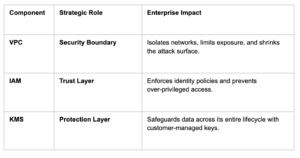
An enterprise AI agent should never operate directly on the public internet with unrestricted access to corporate assets. Production deployments demand isolated infrastructure boundaries, such as Virtual Private Clouds (VPCs). A VPC gives you control over network traffic and access paths, ensuring workloads stay strictly within defined security boundaries.
2. Identity and Access Management (IAM)
Demos typically assume the agent has blanket access to everything. Enterprise environments operate on least-privilege principles. Every action performed by an agent must inherit the exact authorization controls applied to human users. If an employee can’t view a customer record directly, the AI agent acting on their behalf shouldn’t be able to either.
3. Encryption and Key Management
Agents routinely touch sensitive assets—financial records, source code, IP, and personal data. That data must be protected both at rest and in transit. Utilizing customer-managed encryption through tools like AWS Key Management Service (KMS) ensures you retain absolute control over your key material. Encryption isn’t visible in a demo, but it’s the first thing brought up in a security audit.
4. Automated Deployment (CI/CD)
Notebooks and manual scripts break down fast. As models evolve, prompts change, and agent workflows expand, you need repeatable pipelines (like AWS CodePipeline) to test, approve, and promote changes consistently across environments.
5. Full-Stack Observability
When executive leadership asks, “How is the agent performing?” most teams lack the data to answer. Production AI requires deep telemetry into:
- Request volumes and latency
- Response quality and failure rates
- Token consumption and costs
- User interaction patterns
Bottom line: You cannot manage, optimize, or secure what you cannot see.
6. Enterprise Governance
Governance isn’t just a compliance checklist—it’s an operational baseline. You need clear answers to key operational questions: What data was accessed? Which model generated this response? Who approved this action? Achieving this requires immutable audit trails, data lineage, and strict policy enforcement. Without governance, trust collapses—and without trust, enterprise adoption dies.
7. Human-in-the-Loop (HITL) Controls
Fully autonomous agents sound enticing, but practical enterprise deployments rely on intelligent supervision. An agent might analyze data, draft a contract, or compose a customer service response, but a human approves the final execution. This pattern drastically reduces operational risk while preserving productivity gains.
Why Infrastructure Matters More Than the Model
It’s easy to get bogged down in model selection debates—GPT vs. Claude vs. Llama. In practice, your infrastructure architecture matters far more than your choice of model.
An elite model running on an insecure architecture exposes the company to massive liability. An average model operating inside a well-governed, highly secure architecture reliably generates business value.
The Engine Room: The Orchestration Layer
While models generate intelligence, the orchestration layer is where enterprise AI actually happens.
This layer connects your agent to external software and data stores—Salesforce, ServiceNow, databases, S3 buckets, and internal APIs. It acts as the traffic controller, deciding what data can be fetched, enforcing permissions, managing execution flows, and validating output. Intelligence is useless if it cannot be applied safely to your systems.
The Build vs. Partner Decision
None of these architectural components are mysterious. Your team can build them by hand—stitching together cloud VPCs, IAM policies, KMS encryption, deployment pipelines, observability tools, and governance frameworks.
The real question is: Should they?
Do you want your core engineering resources spending the next three to six months assembling plumbing and security controls before delivering actual business value?
That is the fundamental build-versus-partner decision facing technical leadership today. Frameworks designed for enterprise readiness—such as AI Fusion—pre-package these underlying AWS infrastructure requirements, security layers, and orchestration components into a cohesive, production-ready foundation.
Ready to See What Production-Ready Looks Like? Don’t let your AI strategy get stuck in demo land.
Book a demo of AI Fusion to see how you can combine VPC isolation, IAM controls, KMS encryption, and automated governance into an enterprise-ready foundation for your AI agents today.