In Brief
This reference architecture shows how to build governed AI document management on AWS. It identifies records that are current, approved, and authorized before they enter search or RAG.
- Establish document authority. Give every business document a stable identity, owner, lifecycle state, and version history.
- Separate evidence from business meaning. Preserve each source file as evidence. Use the catalog to record provenance, relationships, and domain metadata.
- Keep AI inside the governance workflow. Use AI to propose metadata, then validate and approve it before publication.
- Build retrieval on trusted records. Limit search and RAG to eligible versions, enforce access, and cite the source record.
- Design for operations. Use explicit workflow states and per-record outcomes. Make each write idempotent so failures do not cause duplicate processing.
Key Takeaways:
-
Start with the catalog, not the chatbot: Establish document governance, ownership, and access controls before connecting AI or RAG, ensuring only current and approved records are retrieved.
-
Separate evidence from business meaning: Keep source files immutable in storage while managing domain-specific metadata, lifecycle states, and audit trails in a central catalog.
-
AI proposes, humans approve: Use AI to extract and propose structured metadata backed by source evidence, but require human review and approval before publishing records to search.
-
Model versions and relationships explicitly: Track version history and typed business relationships (such as replaces, supersedes, or attaches to) rather than relying solely on file checksums or vector similarity.
-
Match retrieval to risk and build for resilience: Choose metadata, keyword, or RAG retrieval based on audience risk profiles, enforce security before retrieval, and use idempotent workflows to prevent duplicate processing and unnecessary AI costs
Why AI document management needs governed records
Most organizations do not lack documents. They lack a reliable way to tell which file matters.
Reports, contracts, and slide decks sit in many systems. Search may return three copies of one policy. The results rarely show which copy is current or who approved it.
When an analyst, engineer, or account team searches for a document, matching text is not enough. They need the current approved record for a specific business purpose. They also need its owner, source, access class, and relationship to earlier versions.
That context is often split across source systems, folder structures, and file names. Email threads and subject-matter experts hold the rest. Users must reconstruct it by hand. This slows retrieval and repeats work already completed elsewhere. It also makes critical decisions depending on the few people who know where the authoritative copy lives.
AI increases the impact of this ambiguity. A model can summarize an obsolete draft as confidently as an approved document. It can retrieve content for the wrong audience when document access is not part of the retrieval path. Adding semantic search or RAG to an unmanaged corpus makes uncertain records easier to find, it does not make them trustworthy.
The objective is to establish a governed business record for each document while retaining every source file as evidence. The platform must identify the current version and preserve its provenance and relationships. It must enforce access and record each approval. Only eligible content should enter search and RAG.
A Document Management System (DMS) provides this governance layer. It gives each document a stable identity and owner. It also preserves lifecycle state, access controls, version history, and audit history.
Storage is not knowledge management
Object storage answers one question: where is the file? A DMS must answer more. What is the document? Which version applies? Who may access it? Who approved it?
Consider a file named final_v7_revised.pdf. The name does not show whether it is current. It does not name the owner or the policy it supports. It also says nothing about public access.
AI can summarize the file and propose metadata. A business rule must decide whether the file creates a new version or a new document. A reviewer must approve that decision.
RAG starts with retrieval. A DMS controls the records available to that retrieval path. Start with the catalog, not the chatbot.
Define the catalog before the services
The catalog separates the physical object from its business meaning. Amazon S3 stores source objects and derived artifacts. The document core stores facts shared by every record:
- Stable catalog ID and source-system identifier.
- S3 object key, object version, and checksum.
- Owner, access class, and authorization attributes.
- Lifecycle and publication state.
- Version relationships and audit events.
The type catalog holds domain-specific rules. Each type defines a versioned metadata schema and validation rules. It also defines an extraction contract and search mappings.
A research report may need a study date, method, and subject. An IP record may need inventors, filing dates, and technical classes. A commercial proposal may need an account, region, product, and contract terms.
Do not force every domain into one flat metadata schema. Do not build a separate application for each type. The shared core keeps lifecycle and governance controls consistent. The type catalog isolates domain-specific change.
Before choosing cloud services, agree on six architecture rules:
- Define who may submit, review, approve, and retrieve each document class.
- Retain the source object, extraction evidence, and each review decision.
- Define duplicate, version, and relationship rules.
- Validate domain metadata before publication.
- Make each mutating step idempotent. A retry must not create duplicate records or repeat model calls.
- Select metadata, keyword, semantic, or RAG retrieval for each audience and risk profile.
Reference architecture
The reference design gives every source the same processing path. Only approved, current versions enter a search index or RAG knowledge base.
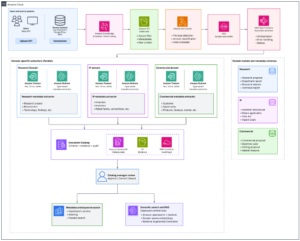
The catalog is the control point in this design. A vector index retrieves similar content. It does not maintain a lifecycle, approval, or authorization state.
Make workflow state explicit
Use named lifecycle states. Operators can then see where processing stopped and who must act next.

AWS Step Functions can orchestrate this process and retain the execution history. The workflow has nine steps:
- Validate the submission. Confirm file type, size, source, and access class.
- Create the document record. Assign a stable ID and record the S3 object version.
- Check duplicates and versions. Compare checksums, then apply domain rules.
- Run the intelligent document processing workflow. scan, read, extract, categorize, and organize meaningful information into accessible formats from large streams of data using Amazon Textract and Amazon Bedrock
- Validate the proposal. Check required fields, formats, values, and domain rules.
- Route the record for review. A catalog manager can approve, correct, reject, or retry it.
- Publish approved content. Index only the search modes allowed for its access class.
The workflow must tolerate partial failure. A scheduled connector may return hundreds of files while a few fail to load or parse. Persist a per-file outcome and a source checkpoint. Retry failed records without replaying completed work.
Use AI to propose metadata, not publish it
AI document processing has two stages. First, a parser or optical character recognition service extracts source evidence. The evidence may include text, pages, tables, forms, layout, and file properties.
A model then uses the evidence and selected type schema to propose metadata. A proposal may include a title, date, document type, topic, entity, summary, or relationship.
Give the model an explicit extraction contract. Define the target fields and allowed values. Require source evidence for each value. Set confidence thresholds and a structured response schema. A request to “find useful metadata” cannot support validation or repeatable evaluation.
Store each proposed value with its source evidence. Record the model ID, prompt version, confidence score, extraction time, and page reference. The catalog manager can then review the proposal without reading the whole file again.
Human approval is a governance control in the primary workflow. It establishes accountability for publication. Review corrections also provide evidence for prompt, rule, and model evaluation.
Define a separate extraction policy for attachments. An attachment can inherit metadata from its primary document. Extract only attachment-specific fields that improve discovery or review.
Model versions, duplicates and relationships explicitly
Search quality depends on more than relevance ranking. The platform must return the correct business record.
The same object may arrive from two source systems. A revision may correct one page. A new edition may supersede last year’s report. An attachment may support several records.
A checksum detects identical bytes. It cannot determine the business relationship between changed files.
Give each business document a stable catalog ID and each revision its own version record. Mark one version as current for standard search. Preserve prior versions and the reason for each change.
Define typed relationships such as attaches to, replaces, derives from, and supersedes. Validate them before publication and prevent circular chains. A vector index cannot maintain this business history.
Choose retrieval by audience and risk
A chat interface should not be the default entry point. Start with the search behavior that the audience and content risk require.
Metadata search supports filters for document type, topic, source, and date. It can also filter by owner, language, and publication status. Users can see why a result appears and open its source record.
This approach suits public or high-risk content. A team can validate the metadata schema and ranking first. It can test the review flow and authorization model at the same time. Free-text or semantic retrieval can follow when the controls are proven.
Internal users may need keyword or semantic retrieval sooner. The authorization model and risk profile should drive that choice. The availability of an embedding model should not.
When the catalog is ready, semantic search can match related terms and languages. RAG can answer questions from approved content. Each answer should cite the source record and document version.
Build security, reliability and cost into the design
Create an idempotency key when ingestion begins. Carry it through queues, workflow executions, and catalog writes. On redelivery, return the existing outcome. Do not create a duplicate record. Do not repeat a model invocation or publish another index entry.
Encrypt content in transit and at rest. Apply least privilege to each service role. Enforce authorization before retrieval. Metadata filters improve relevance, they are not a security boundary.
Keep an audit trail for the source object and object version. Include the extraction results and reviewer changes. Also record the approval decision and publication event. These records help support teams investigate missing, incorrect, or disputed results.
Cost follows the workflow. Reprocessing can repeat Textract pages and Bedrock tokens. It can also add Step Functions state transitions, storage, and index writes. Detect exact duplicates before costly processing. Track failure rates and cost by pipeline stage.
Build the foundation first
Define the document lifecycle and metadata schemas before testing a model. Set the access classes and approval roles in the same design. Specify the provenance and audit evidence that the catalog must retain. If the team cannot identify the current approved record, the content is not ready for search or RAG.
AI can accelerate extraction and classification. The DMS makes the result governed, traceable, and fit for enterprise use.
AllCloud designs and builds AWS data and AI architectures. Our teams connect business requirements, governance controls, and production operations.
Contact our AWS and AI experts to discuss your document platform.