Introduction
Financial institutions operate under strict regulations where data protection and recoverability are critical to maintaining customer trust and business continuity.
Yet many organizations still rely on legacy backup frameworks inherited from on-premises environments that don’t fit AWS’s multi-account architecture or compliance expectations.
That was the case for one major financial organization whose backup approach, originally built for on-premises systems, lacked central governance, automation, and compliance isolation.
To address these gaps, AllCloud partnered with the customer to redesign their backup architecture using AWS Backup, delivering a modern, automated, and compliant solution that strengthened resilience, transparency, and cost efficiency.
Key Gaps Identified
During the assessment, AllCloud identified several critical weaknesses that affected the customer’s ability to maintain reliable, compliant, and cost-efficient backups across their AWS environment.
Lack of Dedicated Backup Ownership
There was no defined team or owner responsible for backup operations, policy enforcement, or restore validation.
Impact: Gaps in governance, monitoring, and SLA accountability, with unclear escalation paths during incidents.
Tag Dependency and Incorrect Values
Backup policies relied on resource tags (for example, backup=true or backup=year), but many resources were either missing these tags or had inconsistent values.
Impact: Critical workloads were unintentionally excluded from backup plans, creating coverage gaps and compliance risks.
Overlapping Policies and Schedules
Some organizational units (OUs) were included in multiple backup plans, leading to redundant copies and conflicting retention periods.
Impact: Increased storage costs and operational complexity due to duplicated recovery points and misaligned retention settings.
Single Vault for All Backups
Both short-term and long-term recovery points were stored in the same AWS Backup vault in the workload account.
Impact: Greater risk of misconfiguration or accidental deletion, and difficulty isolating compliance-related data for audits or retention verification.
Absence of Vault Lock (WORM)
Immutable backups were not enabled for compliance workloads.
Impact: Long-term regulatory data could be deleted or modified, violating immutability and retention requirements mandated by financial regulations.
Lack of Cross-Region or Cross-Account Replication
Critical workloads were only backed up within the same AWS account and region.
Impact: Increased exposure to regional outages, account compromise, or security incidents with no off-site recovery option.
Why These Gaps Mattered
For this financial institution, these weren’t just technical oversights; they represented real risks to data protection, resilience, and compliance.
Unclear ownership reduced accountability, tagging issues left workloads unprotected, and overlapping policies inflated cost.
The lack of immutability and off-site replication exposed the organization to potential data loss, regulatory non-compliance, and extended recovery times during incidents.
These weaknesses made modernization essential; the institution needed a governed, automated, and auditable backup strategy built on AWS best practices.
The AWS Backup Modernization Plan
In close collaboration between AllCloud and the financial institution, a manual and fragmented backup process was transformed into an automated, compliant, and cost-efficient framework designed to enhance resilience, governance, and operational visibility across all environments.
Operational Ownership and Restore Testing
A dedicated Backup Operations Team was established to own governance, monitoring, and restore processes. Automated restore validations in non-production and semi-annual recovery drills in production environments now confirm that recovery objectives (RTO/RPO) can be met reliably and consistently.
Automated Governance and Tagging
Backup governance was standardized and automated. Tags that once depended on manual consistency were now enforced through Infrastructure as Code and validated using AWS Config Rules.
Backup policies were aligned at the Organizational Unit (OU) level, ensuring complete and consistent coverage across environments.
Lifecycle and Cost Optimization
AllCloud streamlined backup schedules and retention policies to eliminate overlap and duplication.
Backups were restructured with tiered lifecycle policies, automatically transitioning data from warm to cold storage (for supported services).
This change reduced long-term retention costs while maintaining accessibility for recovery and audit requirements.
Vault Strategy and Compliance Isolation
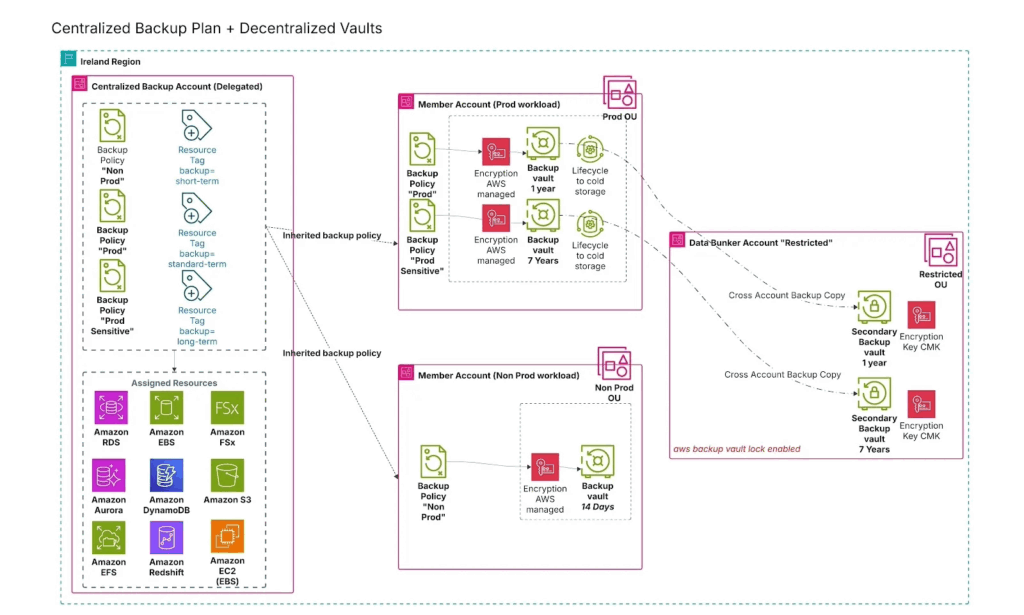
To improve data integrity and meet financial-sector regulations, AllCloud introduced a multi-vault strategy separating operational and compliance backups.
Short-term backups now reside in operational vaults, while long-term and regulatory data are stored in isolated Vault Lock–enabled compliance vaults to prevent misconfiguration or accidental deletion.
Immutability and Retention Enforcement
To protect compliance data from tampering or deletion, Vault Lock (WORM) was enabled with enforced retention periods.
This ensures long-term backups meet immutability and audit requirements mandated by financial-sector regulations.
Cross-Account and Cross-Region Resilience
To protect against regional disruptions or account-level incidents, cross-account and cross-region backup copies were implemented using AWS Backup Vault Copy.
This ensures critical workloads remain recoverable even in the event of a regional failure, improving overall business continuity.
Solution Architecture Overview
Summary
Through collaboration between AllCloud and the financial institution, the organization modernized its backup and recovery strategy to meet strict resilience, compliance, and cost-efficiency goals.
This transformation shows how a well-architected AWS Backup framework can strengthen data protection and governance in the financial sector.
If you’re exploring ways to modernize your own backup and recovery approach, contact AllCloud today to support you in designing a resilient, compliant solution built on AWS best practices.

Hezi Agaian
Cloud Solutions Architect